

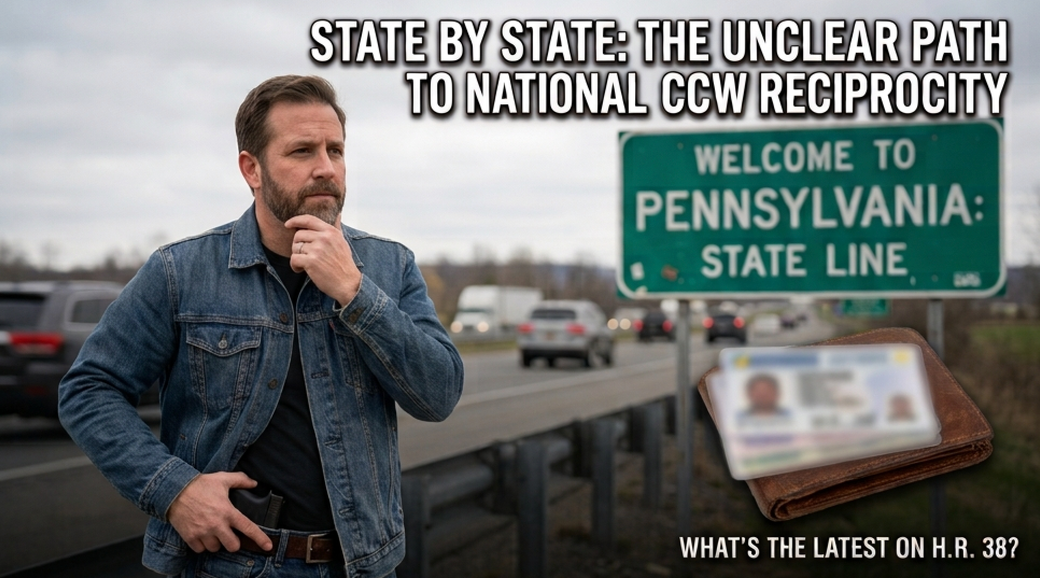
National Concealed Carry Reciprocity: Will Congress Finally Deliver?
Posted by DOT on Jul 22nd 2026
For years, national concealed carry reciprocity has been one of the most discussed and least accomplished goals among Second Amendment advocates.
At a recent rally in Pennsylvania, President Trump once again voiced support for nationwide right-to-carry legislation, telling supporters that his administration is "working on it." While the announcement was met with enthusiastic applause, many gun owners have heard similar promises before.
The Constitutional Concealed Carry Reciprocity Act has been introduced multiple times over the past decade, yet it has repeatedly stalled before becoming law.
This article looks at where the legislation stands today, why it has struggled to pass, and what challenges it would still face even if Congress ultimately approves it.
What Is National Concealed Carry Reciprocity?
Concealed carry reciprocity would require states to recognize valid concealed carry permits issued by other states, much like driver's licenses are recognized across state lines.
Supporters argue that constitutional rights should not disappear simply because someone crosses a state border.
Under proposals such as H.R. 38, lawful permit holders would generally be able to carry concealed firearms while traveling between participating states, subject to certain local rules regarding where firearms may be carried.
A Bill That Has Been Around for Years
Although national reciprocity has recently returned to the headlines, the legislation itself is far from new.
Representative Richard Hudson first introduced the Constitutional Concealed Carry Reciprocity Act in 2017.
Since then:
- The bill has been introduced during multiple sessions of Congress.
- The House passed the legislation in 2017.
- It repeatedly stalled before reaching final passage.
- More recent versions have advanced through committee but have again failed to become law.
Despite continued support among many Republican lawmakers and gun rights organizations, the legislation has yet to overcome the political hurdles necessary to reach the President's desk.
Why Hasn't It Passed?
One of the biggest obstacles has been the Senate.
Even when Republicans controlled both chambers of Congress, national reciprocity failed to secure enough support to overcome the Senate filibuster.
Today, many of those same procedural challenges remain.
Simply having majority support is often not enough to pass controversial firearm legislation through the Senate.
The Challenges Wouldn't End After Passage
Even if Congress ultimately approves national reciprocity, implementation would likely face immediate legal challenges.
Several states currently maintain some of the nation's most restrictive concealed carry policies and do not recognize permits issued by other states.
Among those frequently cited are:
- California
- New York
- Massachusetts
- Connecticut
- Illinois
- Maryland
- New Jersey
- Hawaii
- Rhode Island
- Washington, D.C.
Many legal observers expect states opposed to reciprocity to challenge any federal law in court, potentially leading to years of litigation before the issue is fully resolved.
Why Supporters Continue to Push for Reciprocity
Second Amendment advocates generally argue that constitutional rights should not change based solely on geography.
Many supporters believe:
- Lawfully issued carry permits should receive nationwide recognition.
- Responsible gun owners should not risk becoming accidental criminals simply by crossing state lines.
- The right to bear arms deserves consistent constitutional protection throughout the country.
For travelers, competitive shooters, hunters, and citizens carrying for self-defense, reciprocity has remained one of the most requested federal firearm reforms for years.
What Happens Next?
President Trump's recent comments have once again renewed attention on the issue.
However, public support alone will not move legislation through Congress.
Before national reciprocity becomes law, lawmakers must still:
- Pass the legislation through both chambers of Congress.
- Overcome procedural hurdles in the Senate.
- Address the legal challenges that would almost certainly follow.
Until those steps occur, nationwide reciprocity remains an objective rather than a reality.
Final Thoughts
National concealed carry reciprocity continues to be one of the most significant unresolved issues in modern Second Amendment policy.
While supporters view it as a logical extension of constitutional rights, its path through Congress has proven far more difficult than many anticipated. Similar legislation has been introduced repeatedly over the past decade, yet it has consistently stalled before reaching the finish line.
Whether this latest push gains enough momentum to succeed remains to be seen. If it does, the debate is unlikely to end there, as court challenges from states with restrictive firearm laws are widely expected.
For many gun owners, the broader issue goes beyond reciprocity itself. It reflects the continuing effort to ensure that constitutional rights are recognized consistently, regardless of which state someone happens to be standing in.
At DOT, we believe informed gun owners are empowered gun owners. As firearm legislation and constitutional challenges continue to shape the future of the Second Amendment, staying informed is just as important as having equipment you can depend on.
Explore DOT and experience optics built for performance, reliability, and confidence wherever your next range day or road trip takes you.